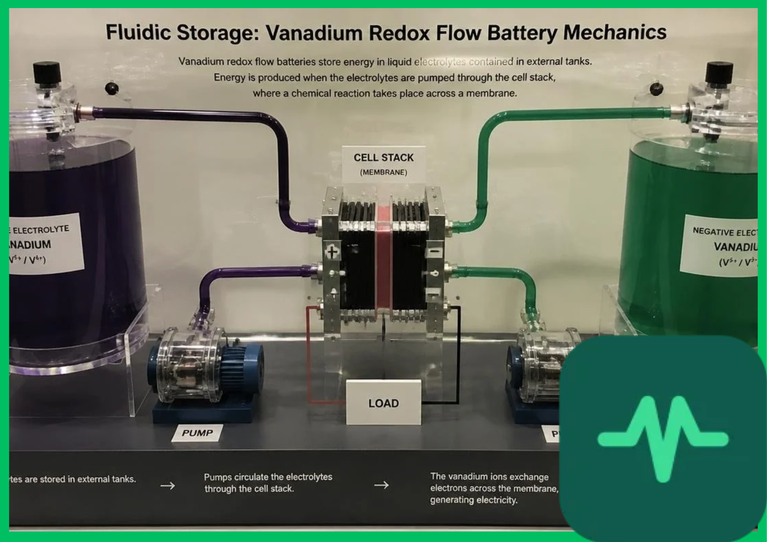
Electrochemical Half-Cell Reactions and Oxidation States
The foundational operating principle of a vanadium redox flow battery relies on utilizing dissolved vanadium ions exhibiting four distinct oxidation states across the negative and positive half-cells. Aqueous sulfuric acid ( ) or hydrochloric acid (
 ) solutions serve as supporting liquid electrolytes, dissolving vanadium salts to maintain high ionic conductivity.
The electrochemical reactions proceeding across the porous carbon felt electrodes during charge and discharge cycles are defined by specific half-cell redox couples:
- Negative Electrode (Anode Side): Operates on the
 redox couple, where divalent vanadium ions (
 ) oxidize to trivalent vanadium ions (
 ) during discharge, releasing electrons into the external circuit.
- Positive Electrode (Cathode Side): Operates on the
 redox couple, where tetravalent oxovanadium ions (
 ) reduce to pentavalent perivandyl ions (
 ) during discharge, accepting electrons from the external circuit.
The overall reversible cell voltage ( ) under standard thermodynamic operating conditions is approximately
 to
 , governed by the Nernst equation based on active ionic concentrations and temperature.
Ion Exchange Membrane Separation and Crossover Mitigation
Separating the negative and positive liquid electrolyte streams within the electrochemical cell stack requires high-performance proton-exchange or anion-exchange membranes. The primary membrane material utilized in industrial VRFB installations is sulfonated tetrafluoroethylene-based fluoropolymer (such as Nafion), which permits selective transport of charge-balancing protons ( ) or sulfate anions while blocking the bulk mixing of liquid electrolytes.
However, concentration gradients across the membrane drive vanadium ion crossover over extended operating cycles. Vanadium ion crossover—where  ,
 ,
 , or
 ions diffuse through microscopic polymer channels—causes capacity imbalance, self-discharge losses, and coulombic efficiency degradation.
Mitigating crossover requires engineering advanced composite membranes incorporating inorganic filler particles, silica nanoparticles, or graphene oxide sheets that restrict pore size distribution. Furthermore, automated active electrolyte rebalancing systems periodically mix and chemically re-adjust electrolyte oxidation states in external holding tanks to restore nominal capacity.
Fluidic Circulation Mechanics and Pumping Parasitic Losses
Unlike stationary solid-state batteries relying on passive solid-state diffusion, vanadium redox flow batteries require continuous mechanical fluid circulation. Centrifugal or positive-displacement pumps transport liquid electrolytes from external storage tanks through distribution manifolds into the porous carbon felt electrodes of the cell stack at controlled flow rates.
Optimizing flow rate dynamics is critical for maximizing system round-trip efficiency. Pumping electrolytes at high velocities reduces concentration polarization overpotentials across the electrode surface, enhancing voltage efficiency and power output. However, high volumetric flow rates increase parasitic pumping power consumption ( ), which can degrade net system efficiency if unmanaged:
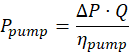
where  is the hydraulic pressure drop across the cell stack,
 is the volumetric flow rate, and
 is the electromechanical pump efficiency. Engineering serpentine flow-field geometries and high-permeability carbon paper electrodes minimizes hydraulic pressure drop (
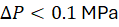 [
 ]), restricting parasitic pumping losses to less than 3% to 5% of total rated system capacity.
Technical Data Specifications of Vanadium Redox Flow Battery Parameters
| Electrochemical & Fluidic Parameter | Engineering Specification Range |
|---|---|
| Nominal Open-Circuit Cell Voltage |  to  DC per cell |
| Electrolyte Concentration (Vanadium) |  to  aqueous solution |
| Supporting Acid Concentration |  to  sulfuric acid (  ) |
Round-Trip Energy Efficiency ( ) | 75% to 85% total energy retention |
| Electrolyte Operating Temperature |  to  (  to  ) |
| Cycle Life Retention (Capacity Fade) |  equivalent full cycles without degradation |
| Parasitic Pumping Power Loss | 3% to 5% of total rated system output |
Thermal Management and Precipitation Kinetics
Maintaining liquid electrolyte temperatures within strict operational boundaries ( to
 [
 to
 ]) is mandatory for preventing irreversible chemical precipitation and thermal degradation.
When operational temperatures drop below  (
 ), pentavalent vanadium ions (
 ) precipitate out of solution as solid
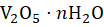 , clogging porous carbon felt electrodes and permanently destroying electrochemical active surface area. Conversely, operating temperatures exceeding
 (
 ) accelerate thermal degradation of polymer ion-exchange membranes and increase hydrogen gas evolution side reactions at the negative electrode. Managing these thermodynamic limits requires integrating external titanium plate heat exchangers into the electrolyte circulation loops to reject excess heat during high-rate charging or supply auxiliary thermal energy in cold-climate installations.
Life-Cycle Assessments and Long-Duration Storage Economics
Evaluating the commercial viability of vanadium redox flow batteries requires analyzing long-duration energy storage (LDES) economics and life-cycle environmental impacts. Citing International Energy Agency energy storage assessments and academic metallurgical research, VRFBs exhibit exceptional operational lifespans exceeding 20,000 equivalent full cycles with negligible active material capacity loss, as liquid vanadium electrolytes do not undergo the solid-phase crystal lattice fatigue that limits lithium-ion longevity.
Although initial capital expenditures remain higher than short-duration lithium-ion installations due to vanadium raw material costs, levelized cost of storage (LCOS) decreases significantly as discharge duration extends beyond 6 to 10 hours. Decoupling power from energy allows system operators to expand storage capacity simply by increasing external tank volumes and electrolyte mass. By combining scalable fluidic storage mechanics with multi-decade operational durability, vanadium redox flow batteries establish an indispensable technical foundation for long-duration grid decarbonization.


Comments (0)
Login to leave a comment.
No comments yet. Be the first to share your thoughts!