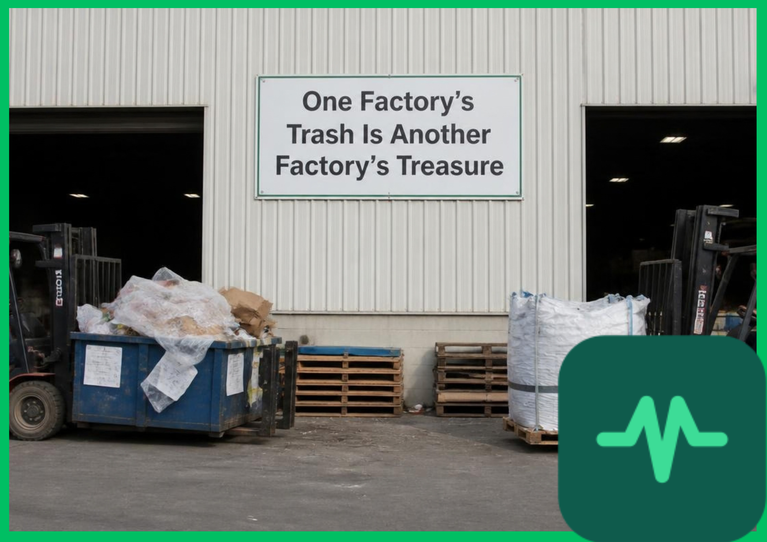
Normally, they'd have nothing to do with each other. But what if the heat from one factory warmed the other? What if the waste from one became the raw material for the next?
This isn't a fantasy. It's already happening.
What an eco-industrial park actually is
An eco-industrial park is a cluster of factories built close together on purpose. They're designed to share resources instead of working alone.
One factory's leftover heat becomes another factory's energy source. One factory's waste becomes another's raw material. Nothing goes to waste if it doesn't have to.
Why this idea makes so much sense
Think about how factories normally work. Each one buys its own raw materials. Each one throws away its own waste. Each one pays for its own energy.
This is wasteful in the most literal sense. Useful heat escapes into the air. Useful materials get buried in landfills. Money gets spent buying things that a neighbor was just throwing away.
Eco-industrial parks fix this. They connect the dots between factories that were never talking to each other before.
A real-world example
Imagine a steel plant. It produces enormous amounts of heat as a byproduct. That heat usually just escapes, wasted.
Now imagine a nearby chemical plant that needs heat for its own process. Instead of burning fuel to create that heat, it simply pipes in the extra heat from the steel plant next door.
The steel plant saves money by not wasting energy. The chemical plant saves money by not buying fuel. Both come out ahead. And less fuel gets burned overall.
How waste becomes raw material
This idea goes further than just heat. Solid waste from one factory can often become raw material for another.
Ash from a power plant can become an ingredient in concrete. Scraps from a food factory can become material for other products. What looks like garbage to one business often looks like opportunity to another.
The honest challenges
Setting this up isn't simple. Factories need to physically sit near each other for many of these exchanges to work well. You can't easily pipe heat across a hundred miles.
Coordination is also tricky. Factories need to agree on schedules, quality standards, and pricing for shared resources. This takes real planning, not just good intentions.
And not every factory fits into this puzzle. Sometimes a business simply doesn't produce anything a neighbor can use.
Why it's worth the effort anyway
Despite these challenges, the payoff is real. Businesses save money on materials and energy. Less waste ends up in landfills. Less pollution enters the air and water.
This isn't charity. It's smart business that also happens to help the planet. That combination is exactly why this idea keeps spreading.
Where this is already working
Several countries have built successful eco-industrial parks. Some islands and smaller regions have become genuine testing grounds, since a smaller, contained area makes coordination easier.
These early examples prove the concept works. They're not just theories in a research paper. They're real places, with real factories, saving real money.
What this means for the products you buy
You might never see an eco-industrial park yourself. But the products you buy could increasingly come from one.
A phone made with recycled metal. A building made with recycled concrete. A shirt dyed using recycled heat. None of this requires you to do anything differently. It just happens quietly, behind the scenes, as more factories adopt this smarter way of working.
Why this fits the bigger circular economy picture
A circular economy is built on one simple rule. Nothing should be wasted if it can be reused.
Eco-industrial parks apply this rule at a massive scale. Instead of individual people recycling bottles at home, entire factories are recycling heat, water, and materials between each other.
This is circular thinking applied to industry itself, not just to households. And industry produces far more waste than households ever could.
The bottom line
Eco-industrial parks take a simple idea and apply it seriously. One business's waste becomes another's resource. Everyone saves money. Less gets thrown away.
This isn't a distant dream. It's already working in real places today. As more factories realize what their neighbors are simply throwing away, expect this idea to keep spreading, quietly reshaping how things get made.
Comments (0)
Login to leave a comment.
No comments yet. Be the first to share your thoughts!