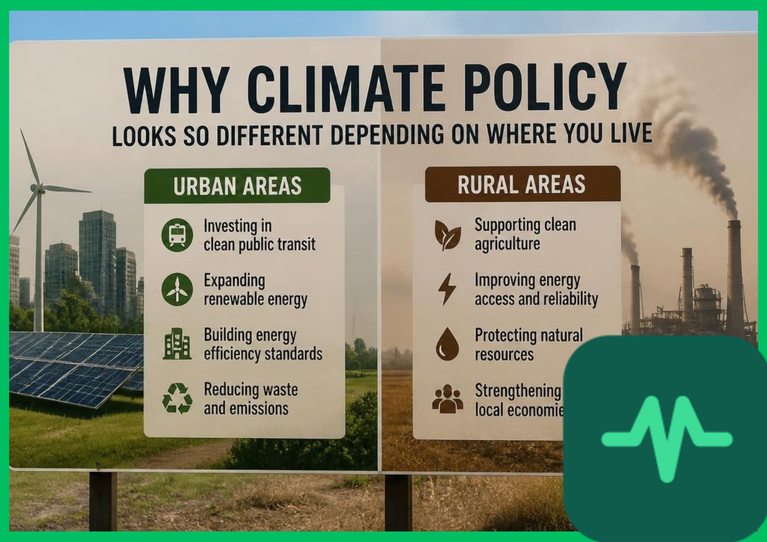
This isn't contradictory reporting. It genuinely reflects how differently climate policy unfolds depending on where you look.
Why climate policy isn't a single, universal approach
Climate change itself is a genuinely global phenomenon, but the policy responses addressing it happen at national and regional levels, each shaped by that specific area's unique economic structure, existing energy infrastructure, political systems, and immediate priorities.
This means there was never a realistic scenario where every region would move forward with identical policy, timing, or intensity. Genuine, honest variation was always the more realistic expectation, however inconvenient that might feel when trying to make sense of it all.
The honest economic factors shaping different approaches
Regions heavily dependent on fossil fuel industries for employment and economic activity face genuinely different considerations than regions with minimal fossil fuel industry presence. Transitioning away from these industries involves genuine, honest economic and social challenges that policy must realistically address, not simply environmental considerations in isolation.
Similarly, wealthier regions often have more available resources to invest in cleaner alternatives and support workers or industries affected by transition, compared to regions facing more immediate, competing economic priorities and genuinely limited resources.
Why political systems genuinely matter here too
Different political systems create different pathways, and different obstacles, for implementing climate policy. Some systems allow for more rapid policy shifts, in either direction, while others involve more gradual, consensus-based processes that naturally move more slowly regardless of underlying intent.
This means climate policy in any given region reflects not just genuine environmental priorities, but also that region's broader political structure and how policy decisions genuinely get made within that specific system.
The honest role of existing infrastructure
Regions with older energy infrastructure, or infrastructure heavily built around older, still-functional systems, may genuinely face more complicated, costly transitions than regions building infrastructure more recently, better positioned to move directly toward cleaner alternatives without addressing significant established infrastructure investment.
This existing infrastructure genuinely shapes what's practically achievable in any given policy timeframe, regardless of ambition or genuine intent behind proposed climate goals.
Why international agreements don't create genuine uniformity
While international climate agreements establish genuinely shared, broad goals, individual regions retain considerable flexibility in determining their own specific policy approaches for meeting those broader commitments.
This flexibility exists partly because international negotiators genuinely recognize that identical, uniform requirements wouldn't realistically account for the honest diversity in circumstances across different regions globally, and insisting on such uniformity would likely undermine broader, genuine participation and cooperation.
What this honest variation means for global progress
Despite this genuine variation in pace and approach, meaningful global progress on climate action continues happening cumulatively, even without every single region moving forward at an identical pace or with identical policy specifics.
Some regions genuinely lead on specific approaches, providing real, practical examples and lessons that other regions can potentially learn from and adapt to their own particular circumstances over time, rather than every region needing to independently develop entirely original solutions.
Why judging global progress by any single region misses the picture
It's genuinely tempting to judge overall global climate progress based primarily on your own region's specific policy environment, whether that leads to excessive optimism or genuine discouragement. Neither reaction provides an accurate, complete global picture on its own.
A more genuinely accurate understanding requires looking at the broader, aggregate global trend, while also honestly acknowledging that meaningful variation exists beneath that broader trend, shaped by countless individual regional decisions and circumstances.
How to stay genuinely informed amid this complexity
Following climate policy news from a genuinely global perspective, rather than exclusively from your own region, helps develop a more complete, honest understanding of this genuinely complex, evolving global picture.
Recognizing that policy shifts, in either direction, within any single region represent just one piece of a much larger, ongoing global effort helps maintain a more balanced, genuinely accurate perspective, rather than reacting primarily to whatever policy news happens to be most immediately visible to you personally.
Why this understanding matters for productive conversations
Understanding why climate policy genuinely varies helps facilitate more productive, honest conversations about climate action generally, rather than conversations that inaccurately assume universal approaches should simply be adopted everywhere identically, regardless of genuinely different underlying circumstances.
This honest nuance doesn't mean every approach is equally effective or that criticism of specific policies is never warranted. It simply means genuine, honest context matters when evaluating and comparing different regions' approaches fairly.
The honest bottom line
Climate policy genuinely varies dramatically around the world because the underlying economic, political, and infrastructure circumstances shaping that policy genuinely vary just as dramatically between different regions.
This honest variation doesn't indicate confusion, contradiction, or that global climate efforts are fundamentally incoherent. It reflects the genuine, honest complexity of addressing a truly global challenge through inherently regional and national policy systems, each navigating their own particular circumstances toward broadly shared, if variably paced, goals.

Comments (0)
Login to leave a comment.
No comments yet. Be the first to share your thoughts!