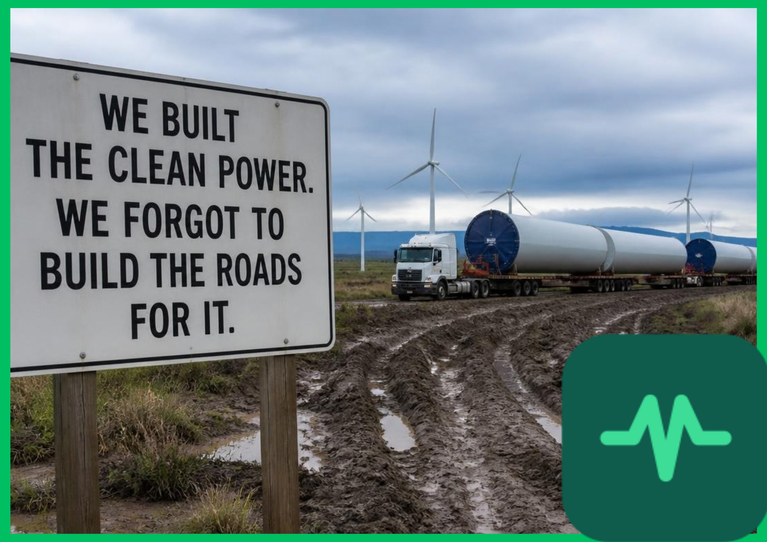
Solar and wind farms keep getting built. The wires and towers needed to carry that power to where it's actually needed haven't kept up nearly as well.
What the grid actually does
Think of the electricity grid as the road system for power. Generation, like solar panels or wind turbines, makes the electricity. The grid carries it from where it's made to where it's actually used.
Without enough grid capacity, even a huge amount of clean power sitting somewhere doesn't help people living somewhere else who actually need it.
Why this gap has opened up
For years, most investment attention went toward building new solar and wind projects. That makes sense, since generation is the exciting, visible part of clean energy.
Grid infrastructure, the actual wires and towers, got less attention and less investment by comparison. This created a real mismatch. We built plenty of new power sources without building enough new pathways to deliver that power everywhere it's needed.
Why this problem matters so much right now
As more solar and wind projects come online, this gap becomes more obvious and more costly. Projects sometimes sit finished, ready to produce power, but stuck waiting for grid connections that simply aren't ready yet.
This wastes real investment and delays the benefits that new clean energy projects were supposed to deliver right away.
The honest scale of investment needed
Fixing this gap requires serious, sustained investment in transmission lines, substations, and modern grid equipment. This isn't cheap, and it isn't quick either.
Recent estimates put global investment in grid infrastructure in the hundreds of billions of dollars, and that figure continues growing as the scale of the challenge becomes clearer.
Why this isn't just about adding more wires
Simply adding more wires isn't the whole answer either. Modern grids also need smarter technology, the kind we've discussed elsewhere, to manage increasingly complex, variable power flows from many different sources at once.
This means grid investment today needs to combine both physical infrastructure and smarter digital systems working together, not just more copper and steel alone.
Why this affects regular people directly
When grid capacity can't keep up, it can mean higher electricity prices in areas where demand strains limited capacity. It can also mean clean energy projects get delayed, slowing down the broader shift toward cleaner power.
This isn't just an abstract industry problem. It shows up in real electricity bills and real delays that ripple through the wider economy.
What's being done to close this gap
Many countries and regions have started prioritizing grid investment more seriously, recognizing that clean energy generation alone isn't enough without the infrastructure to deliver it.
This includes upgrading old transmission lines, building entirely new ones, and modernizing the software and sensors that help manage the whole system more efficiently.
Why this takes so much longer than building a solar farm
A solar farm can often be built within a year or two. Major transmission lines can take considerably longer, sometimes a decade or more, due to the physical scale involved and the many approvals required along the way.
This mismatch in timelines is part of why the gap between generation and grid capacity has grown as wide as it has. One side of the equation simply moves much faster than the other.
Why streamlining approval processes matters
Part of closing this gap involves speeding up how quickly new transmission projects get approved, without cutting corners on genuine safety and environmental review.
Various regions are exploring ways to make this process faster while still maintaining proper oversight, recognizing that excessive delays end up costing everyone in wasted clean energy potential.
What this means if you're watching clean energy news
When you read that a country added an impressive amount of new solar or wind capacity, it's worth remembering that number alone doesn't guarantee that power is actually reaching everyone who needs it yet.
Grid capacity is the quieter, less exciting part of the story, but it genuinely determines how much of that impressive new generation capacity actually gets used effectively.
The bottom line
Building solar and wind farms is only half the real job. Without enough grid capacity to carry that power where it's needed, even impressive new clean energy projects can't deliver their full value.
Closing this gap requires serious, sustained investment and faster approval processes. It's less exciting than a shiny new solar farm, but it may be just as important for making the clean energy transition actually work as intended.
Comments (0)
Login to leave a comment.
No comments yet. Be the first to share your thoughts!