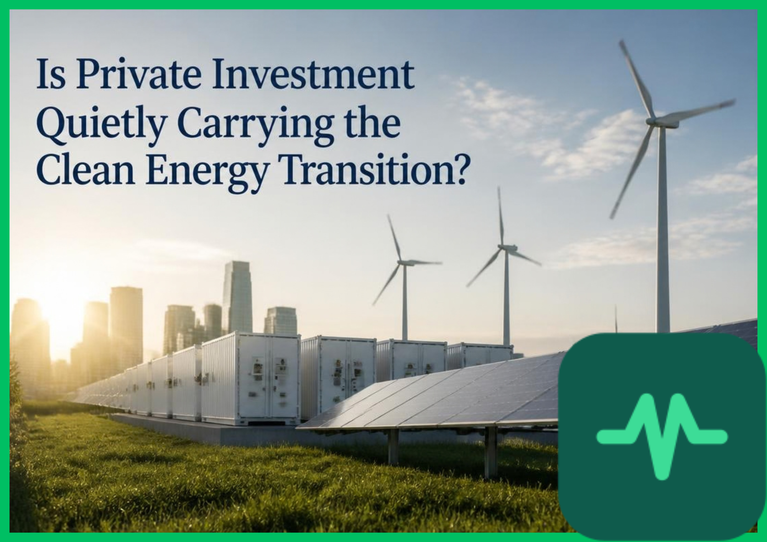
Private investment has been pouring into renewable energy and storage at genuinely record levels. However, sometimes its surrounding policy environments face real, honestly uncertainty or resistance.
The honest scale of private investment happening right now
Recent analysis shows renewable energy investment reaching genuinely record levels globally. This dramatic growth particularly comes from the combined solar-plus-storage projects. This represents substantial, genuine private capital moving into clean energy, independent of, and sometimes despite, specific government policy environments.
This investment pattern suggests something genuinely important. Private investors are increasingly making these decisions based on their own independent economic analysis, rather than purely following government incentives or mandates as the primary driving factor.
Why private investment moving this direction genuinely matters
When private capital flows toward clean energy based on independent economic reasoning, rather than solely because of government requirements or incentives, it suggests genuine underlying economic viability, not simply policy-driven artificial demand that might disappear if policy support changes.
This distinction matters considerably for the long-term durability of the clean energy transition. Investment driven by genuine economic logic tends to prove more resilient through changing political and policy environments than investment purely dependent on maintaining specific government support.
The honest tension worth understanding clearly
This doesn't mean government policy has become irrelevant. Recent analysis has also highlighted genuine tension between accelerating private investment and policy environments that, in some cases, have actively constrained supporting infrastructure development, like transmission systems needed to actually integrate new renewable capacity into existing grids.
This creates an honest, genuinely complicated situation. Private capital wants to invest, and genuinely is investing, while some policy decisions in certain regions have simultaneously limited the infrastructure development needed to fully utilize that investment effectively.
Why market-driven investment shifts tell an interesting story
Beyond raw investment totals, the composition of that investment reveals genuinely interesting patterns. Investment specifically in combined solar-plus-storage projects has grown dramatically, while investment in standalone solar projects without storage has actually declined over the same period.
This shift reflects investors independently recognizing genuine market realities, like the challenges created by too much solar generation without adequate storage during certain hours, and adjusting their investment strategies accordingly, based on practical, honest market conditions rather than policy direction alone.
The honest question this raises about policy's actual role
If private investment continues flowing strongly toward clean energy based on genuine economic reasoning, what role does government policy actually play going forward? This is a genuinely important, honest question worth considering carefully, rather than assuming policy either does or doesn't matter in absolute terms.
Policy remains genuinely important for addressing challenges that private investment alone doesn't naturally solve, like ensuring adequate transmission infrastructure, coordinating complex grid integration, and addressing broader market failures that pure private investment doesn't automatically resolve.
Why infrastructure remains a genuine, honest bottleneck
Even with strong private investment enthusiasm, physical infrastructure limitations, like insufficient transmission capacity connecting new renewable projects to where electricity is actually needed, represent a genuine constraint that private investment alone cannot fully address without supportive policy and coordinated planning.
This suggests the most effective path forward. This likely involves both continued strong private investment and genuinely supportive policy specifically addressing these infrastructure and coordination challenges, rather than either private investment or government policy operating as complete, independent solutions on their own.
What this means for how we think about the clean energy transition
Rather than viewing the clean energy transition as purely dependent on government policy decisions, it's genuinely more accurate to understand it as a combination of increasingly independent private economic decisions, alongside continued, necessary policy support for infrastructure and coordination challenges that markets alone don't naturally resolve.
This more complete, honest picture suggests the transition has genuine momentum extending beyond any single government's specific policy choices, while still depending meaningfully on supportive policy environments to fully realize that momentum's complete potential.
Why this nuance matters for realistic expectations
Understanding this genuine, more complex relationship helps set more realistic expectations. Policy setbacks in specific regions don't necessarily halt broader clean energy progress entirely, given genuine private investment momentum operating somewhat independently. But policy also isn't irrelevant, genuine infrastructure and coordination challenges still require meaningful policy attention.
This balanced, honest understanding avoids both excessive pessimism when specific policy setbacks occur, and excessive complacency assuming private investment alone will completely resolve every remaining challenge without continued policy engagement.
A genuinely hopeful, if complicated, picture
The genuine strength of private investment flowing into clean energy, even amid policy uncertainty in various regions, offers real, legitimate reason for optimism about the transition's underlying momentum and economic viability.
At the same time, honestly acknowledging genuine infrastructure and policy challenges that private investment alone doesn't resolve provides a more complete, realistic picture, rather than either purely celebratory or purely pessimistic narratives that miss this genuine complexity.
The honest bottom line
Private investment is genuinely playing a substantial, perhaps underappreciated role in driving the clean energy transition forward. This is often based on independent economic reasoning rather than purely following government policy direction.
This doesn't make government policy irrelevant, genuine infrastructure and coordination challenges still require meaningful policy attention and support. But it does suggest the clean energy transition has developed genuine momentum of its own, extending beyond any single government's specific policy choices, offering real, honest reason for cautious optimism about its continued progress.


Comments (0)
Login to leave a comment.
No comments yet. Be the first to share your thoughts!